


C Purlin vs Z Purlin for Chennai Factories – Which One Works Best?
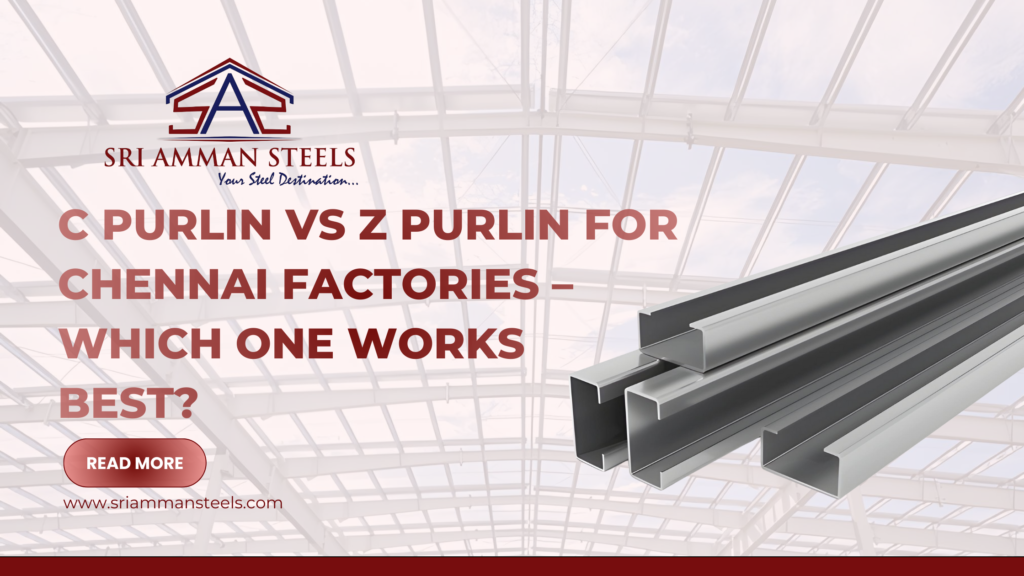
Factories in Chennai face a unique mix of challenges: heat, humidity, coastal corrosion, strong winds during monsoon, and large-span industrial sheds. Because of this, choosing the right structural components is not optional — it directly affects roof life, safety, and maintenance cost.
One of the most common questions factory owners and PEB contractors ask is:
C purlin vs Z purlin for Chennai factories — which one should we use?
Let’s break it down in a clear, local, and practical way.
Why Purlin Selection Matters for Factories in Chennai
In Chennai and nearby industrial belts like Ambattur, Sriperumbudur, Oragadam, Maraimalai Nagar, and Ennore, factory buildings usually have:
Large roof spans
Heavy roofing sheets (PPGL or insulated panels)
Exposure to humidity and coastal air
High wind load during monsoon
Purlins support the roofing system and transfer loads to the main frames. If the wrong purlin type is chosen, problems like roof sagging, vibration, leakage, and corrosion show up faster — especially in Chennai’s climate.
Understanding C Purlins
What is a C Purlin?
C purlins have a C-shaped cross-section and are commonly used as secondary structural members in PEB and industrial buildings.
Where C Purlins Are Used in Chennai Factories
C purlins are typically used for:
- Small factory sheds
- Wall girts in PEB structures
- End bays of roofing systems
Mezzanine floors and internal platforms
Pros of C Purlins
- Easy to fabricate and install
- Lower initial cost for small spans
- Suitable for compact industrial units
Limitations in Chennai Conditions
- Not ideal for long roof spans
- Cannot be overlapped at joints
- Requires more material for large roofs
- Less efficient under high wind load
For small factories in non-coastal areas, C purlins work fine. But for larger sheds common in Chennai, their limitations become clear.
Understanding Z Purlins
What is a Z Purlin?
Z purlins have a Z-shaped profile designed specifically for long-span roofing systems.
Why Z Purlins Are Widely Used in Chennai Factories
Most modern factories in Chennai prefer Z purlins because they:
- Can be overlapped at joint
- Handle longer spans efficiently
- Reduce overall steel usage
- Perform better under wind load
Common Applications in Chennai
Z purlins are widely used in:
- Large manufacturing units
- Automotive factories
- Warehouses and logistics hubs
- Export-oriented units near coastal zones
PEB industrial sheds
Because Chennai factories often require wide, column-free spaces, Z purlins are structurally more efficient.
Common Applications in Chennai
Z purlins are widely used in:
- Large manufacturing units
- Automotive factories
- Warehouses and logistics hubs
- Export-oriented units near coastal zones
PEB industrial sheds
Because Chennai factories often require wide, column-free spaces, Z purlins are structurally more efficient.
| Factor | C Purlin | Z Purlin |
|---|---|---|
| Span capability | Short to medium | Medium to long |
| Overlapping | Not possible | Possible |
| Wind load performance | Moderate | Better |
| Steel efficiency | Lower | Higher |
| Suitability for Chennai | Limited | Highly suitable |
| Common use | Walls, small sheds | Roofs, large factories |
Which Purlin Is Better for Chennai Factories?
For most factories in Chennai:
- Z purlins are the better choice for roofing
C purlins are better suited for walls and secondary areas
In real projects, the best approach is not choosing one over the other — but using both correctly.
A typical Chennai factory setup uses:
- Z purlins for roof spans
C purlins for wall girts and end bays
This balances strength, cost, and performance.
Cost Perspective in Chennai Projects
At first glance, C purlins may appear cheaper. But in Chennai factory projects:
- Z purlins reduce the number of supports
- Steel usage is optimized
- Installation time is faster
- Long-term maintenance cost is lower
So while Z purlins may cost slightly more per unit, they often reduce total project cost for large sheds.
Common Mistakes Seen in Chennai Factory Projects
Some frequent mistakes include:
- Using C purlins for long roof spans
- Ignoring wind load calculations
- Choosing non-galvanized purlins in coastal zones
Selecting purlins based only on price
These mistakes lead to early roof issues, especially in Chennai’s humid and coastal environment.
Why Galvanization Is Critical in Chennai
Due to humidity and salt air:
- Non-galvanized purlins corrode quickly
- Corrosion weakens structural members
Roof life reduces significantly
For Chennai factories, galvanized C and Z purlins are not optional — they are essential for durability.
In a Nutshell
When it comes to C purlin vs Z purlin for Chennai factories, the answer is clear:
Z purlins are the preferred choice for factory roofing
C purlins are best for walls and smaller secondary structures
The right purlin choice improves roof strength, reduces maintenance, and ensures long-term performance in Chennai’s demanding climate.
If you’re planning a factory, warehouse, or PEB shed in Chennai, always select purlins based on span, load, and environment — not just upfront cost.
Frequently Asked Questions
1. What is the main difference between C purlin and Z purlin?
The main difference is shape and span performance. C purlins have a C-shaped section and are suitable for shorter spans, while Z purlins have a Z-shaped section and can be overlapped, making them ideal for longer spans and heavier factory roofs.
2. Which purlin is better for large factory sheds in India?
Z purlins are generally better for large factory sheds in India because they handle long spans, heavy roofing sheets, and wind loads more efficiently.
3. Can C and Z purlins be used together in a factory building?
Yes. In most factory projects, Z purlins are used for roof spans, while C purlins are used for wall girts, end bays, and smaller secondary structures.
4. Are Z purlins more expensive than C purlins?
Z purlins may appear costlier per piece, but they often reduce total steel usage and the number of supports required. For large factories, Z purlins usually lower the overall project cost.`
5. What thickness of purlins is commonly used for Indian factories?
Typical thickness ranges from 1.6 mm to 3.0 mm, depending on span, load, and roof type. Final thickness should always be decided based on structural calculations.
6. Are galvanized purlins necessary for factory buildings?
Yes. Galvanized purlins are strongly recommended, especially in humid or coastal regions in India, as they offer better corrosion resistance and longer lifespan.
7. Why are Z purlins preferred in PEB structures?
Z purlins allow overlapping at joints, which improves load distribution and structural continuity. This makes them ideal for PEB factories and warehouses with large roof spans.
8. What happens if the wrong purlin type is used in a factory?
Using the wrong purlin can lead to roof sagging, vibration, leakage, reduced load capacity, and higher maintenance costs over time.
