


What Are Decking Sheets and Why Modern Buildings Rely on Them?
If you’ve noticed how fast buildings go up today – commercial complexes, warehouses, high-rise towers, multi-level parking structures – it isn’t magic. It’s better materials and smarter construction methods.
Decking sheets are a big part of that shift. Builders use them because they save time, cut labor, reduce concrete usage, and create stronger floors without complicating the project.
What are decking sheets?
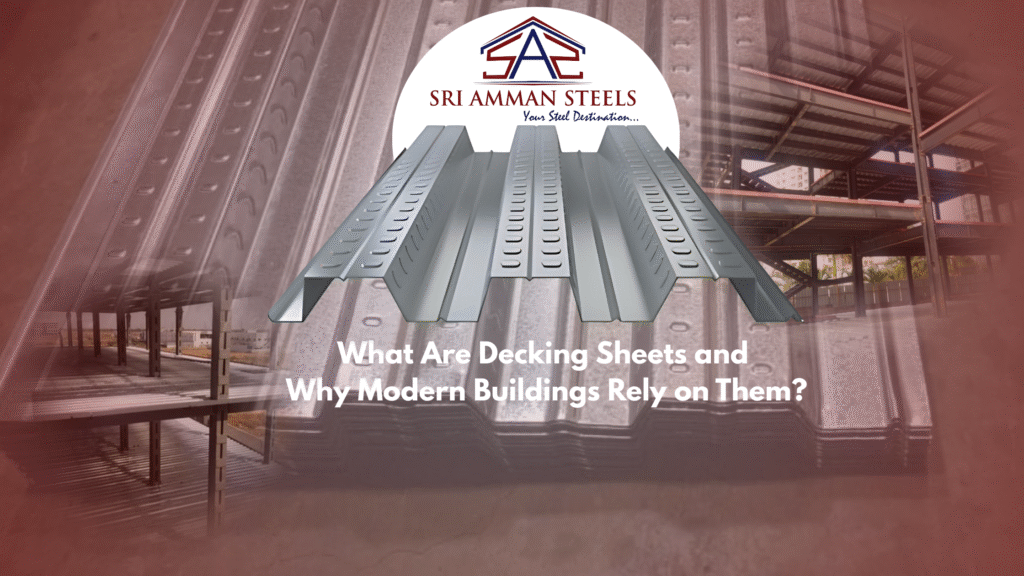
Decking sheets are steel sheets having a ribbed or profiled design that provide a robust base for concrete slabs.
Just think of them as permanent formwork that remains in a building and supports it throughout its life.
A decking sheet does three jobs at once:
- Acts as shuttering during slab casting
- Adds tensile strength to the slab
- Supports heavy loads in industrial and commercial buildings
Slab becomes stronger without increasing thickness, because the sheet and concrete work together.
Why builders love them
Here’s the simple truth:
Decking sheets replace conventional shuttering and centering work. No wooden planks. No dismantling. No delays.
1. Speedier Construction
No need to fix and remove wooden shuttering.
The decking sheet becomes the base, saving days of labour.
2. Stronger composite slabs
The steel profile clamps the concrete, enhancing load capability, which becomes crucial for warehouses, mezzanine floors, and multi-storey buildings.
3. Less concrete required
The ribbed design reduces the quantity of concrete required without compromising strength.
4. Safer during construction
The decking sheet is put into place whereby workers can pour concrete while walking on it.
5. Long-term durability
Since the sheet stays in the building, it keeps supporting the structure for decades.
The combination of speed, strength, and cost-efficiency has made decking sheets part of almost every modern project.
Real-World Use Cases
Since the sheet stays in the building, it keeps supporting the structure for decades.
The combination of speed, strength, and cost-efficiency has made decking sheets part of almost every modern project.
High-rise buildings in Chennai & Coimbatore
Decking sheets are employed by builders for every floor because concrete sets quicker, thus moving the construction more swiftly, and the structure remains lighter yet strong.
Industrial sheds and PEB structures
Decking sheets help to create robust mezzanine floors without heavy civil work. Factories use them to support equipment, storage, and office floors.
Warehouses and logistics centers
They provide stable, high-load mezzanine floors to support pallets, forklifts, and racking systems.
Commercial complexes and malls
Decking sheets help build large-spanning floors with fewer columns, giving more usable floor space.
Multi-level car parking
These structures rely heavily on decking sheets because they offer strong, low-maintenance floors that handle continuous load.
Metro stations, airports, and IT parks
When the project cannot afford delays, decking sheets help speed up the entire RCC process.
In short, anywhere speed, strength, and safety matter, decking sheets outperform old-school shuttering.
Why Sri Amman Steels Is a Good Choice
In decking sheets, consistency and load-carrying capacity remain more crucial than anything. Sri Amman Steels offers:
- High-tensile decking sheets with strong profiles
- Thickness options suitable for light to heavy loads
- Sheets that bond well with concrete and don’t deform
- Reliable delivery across Tamil Nadu
- Guidance on choosing the right thickness and profile based on span
- Support for builders, contractors, and industrial clients
You get material you can trust—and support you can depend on throughout the project.
If you are planning a multi-storey building, a warehouse, a mezzanine floor, or a project that requires faster and stronger slab construction, then decking sheets can save your time, labour, and cost.
Share your project details with us anytime, and we’ll help you choose the right profile and thickness without overcomplicating anything.
Frequently Asked Questions

1. What exactly are decking sheets?
Decking sheets are cold-formed, profiled steel sheets used below concrete slabs to act as permanent shuttering and structural support. Their ribbed or corrugated design allows them to carry wet concrete during casting and then work together with the hardened concrete as a composite floor system.
2. How do decking sheets make slabs stronger without increasing thickness?
In a composite slab, concrete handles compression at the top while the steel decking takes tensile forces at the bottom, so both materials share the load efficiently. The interlocking ribs or embossments on the sheet ensure strong bonding with concrete, increasing load capacity without needing to increase slab thickness.
3. How do decking sheets speed up construction compared to conventional shuttering?
Decking sheets act as ready-made, stay-in-place formwork, so there is no need to install and dismantle wooden shuttering or centering after casting. This reduces labour, avoids delays in removing formwork, and can shorten floor cycle times by a significant margin on multi-storey projects.
4. Do decking sheets reduce concrete and steel consumption?
Yes, the profiled shape of the decking reduces the volume of concrete needed for the slab while still achieving the required structural performance. Because the deck itself contributes to tensile reinforcement, the quantity of traditional rebar in the slab can also be reduced, leading to overall material savings.
5. Are decking sheets safe for workers during construction?
Once fixed to the supporting beams, decking sheets create a stable working platform for workers to walk on while placing reinforcement and pouring concrete. This reduces the need for temporary scaffolding and provides a safer, more continuous surface, lowering the risk of falls and improving site productivity.
6. Where are decking sheets commonly used?
Decking sheets are widely used in high-rise buildings, industrial sheds, PEB structures, warehouses, commercial complexes, and multi-level car parks where faster floor cycles and high load capacity are important. They are also preferred in infrastructure projects such as metro stations, airports, and IT parks where delays are costly and strict safety and performance standards apply.
7. What thickness and profiles are typically available?
In India, structural steel decking sheets are commonly available in thicknesses ranging from about 0.8 mm to 1.5–2.0 mm, depending on the load requirement and span. Profiles usually have rib depths around 44–51 mm (and similar variants), with cover widths near 950–1000 mm, designed to balance strength, stiffness, and concrete bonding.
8. How do decking sheets perform over the long term?
Galvanized steel decking sheets are designed for durability, offering resistance to corrosion, impact, and weathering when correctly specified and protected by the concrete cover. Because they remain part of the structure as permanent formwork, they continue to contribute to slab strength and stiffness throughout the building’s life.
9. Are decking sheets suitable for heavy industrial loads and mezzanine floors?
Properly designed composite slabs with decking sheets can carry high point loads and distributed loads, making them well-suited for warehouses, racking systems, forklifts, and industrial mezzanine floors. By selecting the right sheet thickness, profile, and span, engineers can achieve robust floors without heavy civil work or thick slabs.
10. Why choose a supplier like Sri Amman Steels for decking sheets?
A specialist supplier in Tamil Nadu such as Sri Amman Steels can provide high-tensile, branded galvanized decking sheets in suitable thicknesses, along with matching roofing and steel products. Working with an experienced dealer helps ensure consistent quality, reliable delivery in cities like Chennai and Coimbatore, and guidance on selecting the right profile and thickness for each project span and loading.
11. How do I select the right decking sheet for my project?
Selection typically depends on span between beams, design load (storage, parking, office use), fire rating requirements, and construction sequence. Sharing basic project details with the supplier or structural engineer allows them to recommend a suitable profile, thickness, and support spacing that balances safety, speed, and cost.
